# Client Side Prototype Pollution
{% hint style="success" %}
Learn & practice AWS Hacking:[**HackTricks Training AWS Red Team Expert (ARTE)**](https://training.hacktricks.xyz/courses/arte)\
Learn & practice GCP Hacking: [**HackTricks Training GCP Red Team Expert (GRTE)**](https://training.hacktricks.xyz/courses/grte)
Support HackTricks
* Check the [**subscription plans**](https://github.com/sponsors/carlospolop)!
* **Join the** 💬 [**Discord group**](https://discord.gg/hRep4RUj7f) or the [**telegram group**](https://t.me/peass) or **follow** us on **Twitter** 🐦 [**@hacktricks\_live**](https://twitter.com/hacktricks_live)**.**
* **Share hacking tricks by submitting PRs to the** [**HackTricks**](https://github.com/carlospolop/hacktricks) and [**HackTricks Cloud**](https://github.com/carlospolop/hacktricks-cloud) github repos.
{% endhint %}
## Discovering using Automatic tools
The tools [**https://github.com/dwisiswant0/ppfuzz**](https://github.com/dwisiswant0/ppfuzz?tag=v1.0.0)**,** [**https://github.com/kleiton0x00/ppmap**](https://github.com/kleiton0x00/ppmap) **and** [**https://github.com/kosmosec/proto-find**](https://github.com/kosmosec/proto-find) can be used to **find prototype pollution vulnerabilities**.
Moreover, you could also use the **browser extension** [**PPScan**](https://github.com/msrkp/PPScan) to **automatically** **scan** the **pages** you **access** for prototype pollution vulnerabilities.
### Debugging where a property is used
{% code overflow="wrap" %}
```javascript
// Stop debugger where 'potentialGadget' property is accessed
Object.defineProperty(Object.prototype,'potentialGadget', {__proto__:null, get(){
console.trace();
return 'test';
}})
```
{% endcode %}
### Finding the root cause of Prototype Pollution
Once a prototype pollution vulnerability has been identified by any of the tools, and if the code is not overly complex, you might find the vulnerability by searching for keywords such as `location.hash`, `decodeURIComponent`, or `location.search` in the Chrome Developer Tools. This approach allows you to pinpoint the vulnerable section of the JavaScript code.
For larger and more complex codebases, a straightforward method to discover the vulnerable code involves the following steps:
1. Use a tool to identify a vulnerability and obtain a payload designed to set a property in the constructor. An example provided by ppmap might look like: `constructor[prototype][ppmap]=reserved`.
2. Set a breakpoint at the first line of JavaScript code that will execute on the page. Refresh the page with the payload, pausing the execution at this breakpoint.
3. While the JavaScript execution is paused, execute the following script in the JS console. This script will signal when the 'ppmap' property is created, aiding in locating its origin:
```javascript
function debugAccess(obj, prop, debugGet=true){
var origValue = obj[prop];
Object.defineProperty(obj, prop, {
get: function () {
if (debugGet)
debugger;
return origValue;
},
set: function(val) {
debugger;
origValue = val;
}
});
};
debugAccess(Object.prototype, 'ppmap')
```
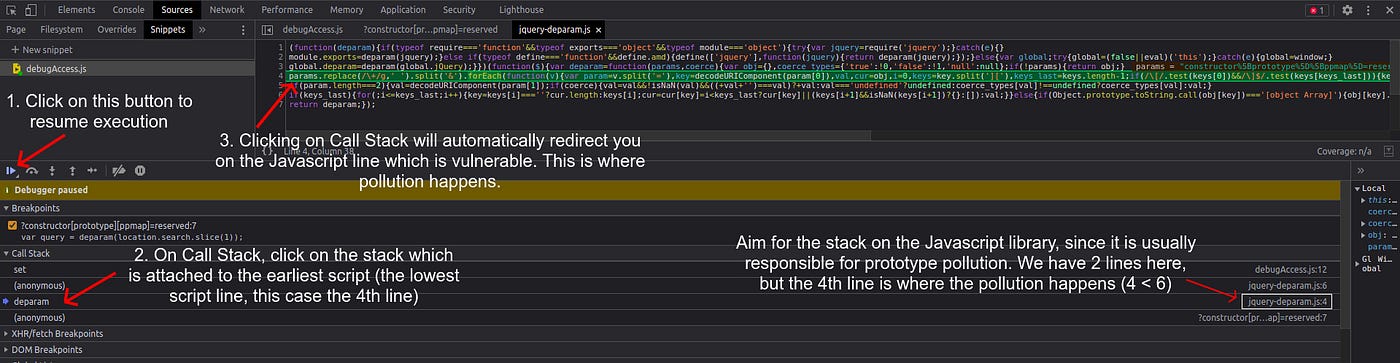
4. Navigate back to the **Sources** tab and select “Resume script execution”. The JavaScript will continue executing, and the 'ppmap' property will be polluted as expected. Utilizing the provided snippet facilitates the identification of the exact location where the 'ppmap' property is polluted. By examining the **Call Stack**, different stacks where the pollution occurred can be observed.
When deciding which stack to investigate, it is often useful to target stacks associated with JavaScript library files, as prototype pollution frequently occurs within these libraries. Identify the relevant stack by examining its attachment to library files (visible on the right side, similar to an image provided for guidance). In scenarios with multiple stacks, such as those on lines 4 and 6, the logical choice is the stack on line 4, as it represents the initial occurrence of pollution and thereby the root cause of the vulnerability. Clicking on the stack will direct you to the vulnerable code.
## Finding Script Gadgets
The gadget is the **code that will be abused once a PP vulnerability is discovered**.
If the application is simple, we can **search** for **keywords** like **`srcdoc/innerHTML/iframe/createElement`** and review the source code and check if it l**eads to javascript execution**. Sometimes, mentioned techniques might not find gadgets at all. In that case, pure source code review reveals some nice gadgets like the below example.
### Example Finding PP gadget in Mithil library code
Check this writeup:
## Recompilation of payloads for vulnerable libraries
*
*
## HTML Sanitizers bypass via PP
[**This research**](https://research.securitum.com/prototype-pollution-and-bypassing-client-side-html-sanitizers/) shows PP gadgets to use to **bypass the sanizations** provided by some HTML sanitizers libraries:
* **sanitize-html**
* **dompurify**
* **Closure**
```html
```
## References
*
*
* [https://research.securitum.com/prototype-pollution-and-bypassing-client-side-html-sanitizers/#:\~:text=my%20challenge.-,Closure,-Closure%20Sanitizer%20has](https://research.securitum.com/prototype-pollution-and-bypassing-client-side-html-sanitizers/)
{% hint style="success" %}
Learn & practice AWS Hacking:[**HackTricks Training AWS Red Team Expert (ARTE)**](https://training.hacktricks.xyz/courses/arte)\
Learn & practice GCP Hacking: [**HackTricks Training GCP Red Team Expert (GRTE)**](https://training.hacktricks.xyz/courses/grte)
Support HackTricks
* Check the [**subscription plans**](https://github.com/sponsors/carlospolop)!
* **Join the** 💬 [**Discord group**](https://discord.gg/hRep4RUj7f) or the [**telegram group**](https://t.me/peass) or **follow** us on **Twitter** 🐦 [**@hacktricks\_live**](https://twitter.com/hacktricks_live)**.**
* **Share hacking tricks by submitting PRs to the** [**HackTricks**](https://github.com/carlospolop/hacktricks) and [**HackTricks Cloud**](https://github.com/carlospolop/hacktricks-cloud) github repos.
{% endhint %}
---
# Agent Instructions: Querying This Documentation
If you need additional information that is not directly available in this page, you can query the documentation dynamically by asking a question.
Perform an HTTP GET request on the current page URL with the `ask` query parameter:
```
GET https://angelica.gitbook.io/hacktricks/pentesting-web/deserialization/nodejs-proto-prototype-pollution/client-side-prototype-pollution.md?ask=
```
The question should be specific, self-contained, and written in natural language.
The response will contain a direct answer to the question and relevant excerpts and sources from the documentation.
Use this mechanism when the answer is not explicitly present in the current page, you need clarification or additional context, or you want to retrieve related documentation sections.